
BACK TO THE WATER

Life looks a little different over here in the Gonsoulin house lately. Adding two kids at once to the family never was the plan, but I can’t say it hasn’t been a joyful and exciting ride (except for the part about no sleep). Ivy Rose and Coral Mae Gonsoulin made their debut on June 5th around 5:00 PM, and they haven’t looked back since. A little rough on the delivery, but thankfully both Momma and babies are both doing well, and our two boys are excited to have two new baby sisters. Mom and Dad are TIRED.
Nonetheless, I took almost a month off the water to welcome the girls to the world and to adjust to having 4 kids rather than 2, which is a work in progress, but I will say upon returning to the water on July 8th our trout fishing has been all gas and no brakes. Lots of 25-27” fish, at least one or two every day, plenty going over the 28” mark, and one long one that touched over the 30” mark. No weight to most of these fish, except one fat 26” fish that still had eggs, but you can’t complain about the quality of the length!
So, what happens on the first day back when you’ve been off the water for a while? Where do you start? After taking a poll on Instagram, most of you said you wanted to know how I approached the first day back on the water after a long hiatus. So, this blog article is going to walk you through exactly how my first day back went and my thought process behind building the pattern I used to be successful.
To preface this, let me discuss for a second the pattern built here and my thoughts going into the day. I keep a good log of every day I fish and have done so for the last 10 years (been slacking lately but for the most part I’ve got pretty good notes) and July historically tells us that bigger trout are going to be holding on shallow flats during the feeding portions of the day and the larger fish will usually stay put as to not expend too much energy. We do see them move deeper when water temperatures get stupid but below 90, I have seen more big fish stay right in the structure they were feeding in rather than moving deep. And if they do move deep, it is always within a short distance, maybe a hundred yards. The goal of this time of year is to not expend too much energy, therefore it is not cost effective for them to move too far.
Conditions : Sunny / Slightly Overcast
Wind : 10-20 SSE
Tide : -0.1 – 0.1 NOAA Baffin (Low Tide)
Major : Approx 4-6AM
Minor : Approx 11-12PM
Air Temperature : 78-95+
Water Temperature : 84-90
Moon Phase : Waning to New
5:45 AM
Meeting clients at the dock to begin the day. I usually like to arrive at least 15 minutes early so I have enough time to sit in silence and sip my coffee and create a mental image of how I want the day to go. This is largely when I plan what areas I want to fish within the parameters of the conditions. For the next week we were set to have a steady south wind with hot air and water temperatures, with a very early morning feed followed by a mid-day feed around noon. Even though water temperatures were already starting near 85 degrees, I imagined that the trout would be feeding shallow over sandbars and flats with scattered structure and a good bit of current. Whether they move deeper or not will have to be a gametime observation.
Another sip of coffee. Flip Capt. Ryan Aguirre the bird, just for fun.
Clients are here and ready to go, time to roll.
6:15 AM
Arriving on station at our first area. A long sandbar with multiple tiers of a flat coming off of it, with the top of the flat being around knee to thigh deep and the secondary flat being anywhere from thigh to waist deep water. Cutting the engine I start scanning the water as I always do. Observation is everything, assume nothing. You aren’t God or a fish, don’t act like either of them. Watch, absorb, learn, every day. Looking over the flat my first observation was there was very little bait up high on the flat in knee deep water, but the bait I did see up there was all small mullet and menhaden. History tells us that during the beginning of summer these trout are not eating big mullet yet, they are keying on the smaller 4-6” baitfish. A small menhaden flip, a 4” mullet shooting out of the water. Bingo. Knowing the preferred forage of the season and the bay system can go a long way when building a pattern quickly. Gear up, jump out.
7:00 AM
Nothing huge to start but we missed a few key bites and caught a few solid slot fish. With smaller mullet darting across the thigh deep flat, it was only a matter of time before we got a big bite. Tanner hooks up on a heavy fish that pulls off on the hookset, on the same cast I get that distinctive thump. Reel down, rod loads up, white water. Heavy fish going right at 27” and 6.25lbs. Now that the sun is up a little we can start to see the scattered grassbeds on this flat and that fish came from the western corner of that particular grassbed. We planted our feet for a few minutes and worked this area over after coming into contact with the right fish, another 10 minutes later we can see the grassbeds even better and now we are able to sightcast to individual grassbeds. Still good amounts of slot fish but nothing huge. Time to move.
9:00 AM
Entering the dead period of the day. We had a major early and were expecting another bite during the midday. During periods of low activity I like to find areas where it is easy for a trout to stage and feed at the same time. Specifically, moving water over good structure. Making a short run we stopped on a windblown point with a long sandbar extending out into a deeper flat. There was plenty of bait stacked on the leeward side of the bar as well. Now I know this may seem backwards, but over the past couple of years I have noticed that in moving water situations it almost seems that trout prefer to stage on the leeward side of the structure in order to let the current bring the bait to them and use the sandbar as cover. Wading up to the bar we did not get bit until we started throwing right up against the bar and over it. Tanner was the first to stick a fish and it was a solid 25” or better but it popped off at his hand. Mike stuck a few ore 19-22” fish as we waded down the bar continuing to cast beyond the bar and bring the bait up to the leeward edge of the bar. Looking back, it would have been a great strategy to tie on a small topwater and cast on the windward edge of the bar and free line the lure, letting the current and wind take it over the bar naturally. We could have been bit by some larger fish doing this I feel, but I wasn’t quick thinking enough. Another few slot trout on this wade and it was time to move on.
10:00 AM
Middle of the dead period between feeds. We moved off of the sandbar point now moving a few miles further onto a shoreline that is similar to our first area. Shallow flat up close to shore, dropping to a thigh deep flat, further dropping to another flat in waist deep to belly deep water. All with scattered grassbeds and potholes. If the trout were going to be moving deeper, this is when they would make the move so I wanted to fish an area that was a little deeper. Observing the area before jumping out, I noticed the small bait was on the deeper line in about crotch deep water so this is where we lined up. To say it was slow was an understatement, but we stayed observant. Despite dirty water, we were watching 25” trout swim by us and they wanted nothing to do with our offerings. It just simply wasn’t time yet. When faced with these situations I try to resist the urge to make a move. The grass isn’t always greener on the other side, and unless my move is going to be a new game plan entirely, I try to stay put, especially if I am seeing all the right things that tell me what I want is there. Now here’s the downside to that plan. Waiting hours on end for them to turn on is grueling, especially in the summertime with clients who are paying good money to get bites. So sometimes we have to move even though we may be leaving a productive area. That is where this next move came from.
11:30 AM
Knowing a major feed was upcoming around 12:00 PM, we made a short move down the shoreline to similar structure where I had seen a few pelicans hitting the water. This section of the shoreline comes to a point where water flows around the shoreline and stacks bait along the windward side. In the heat of the summer, I never think a little extra water movement is a bad thing. Upon arriving in the area, I could immediately see baitfish scrambling in the scattered grassbeds up shallow. Now this may seem a little backward, its almost noon and water temperatures are nearing the 88-degree mark. Shouldn’t they be moving to deeper water? Not necessarily. As I said earlier, the goal of summer is to expend as little of energy as possible. And larger trout will put up with a lot to stay safer and make sure they can eat easy. Warmer water temperatures included. Especially if they have a quick exit, which in this case they had an exit within 100 yards. Bailing out of the boat in thigh deep water over sand and scattered grassbeds, it did not take long. I think it was my fifth cast with a Half Baked Coastal Brew dart that got slammed. Reel down, tight line, perfect. A very heavy and large fish came to the surface, gills flaring and absolutely pissed off. At least enough to send that jighead right back where it came from. She got me before I had a chance to back off the drag a click or two. I always like to keep my drag hammered but when I realize I’ve got a good fish I back my drag off 3-4 clicks to allow that fish to have a little room to run without my line being too taunt. Not sure how big that one was but based on her head I am sure it was a 28”+ fish. No matter, I will get another one. Guys, it doesn’t help to dwell on the past. I see a lot of clients and anglers walking back to the boat, sitting down, head in their hands after they lose a great fish but here’s the truth. There’s another one sitting right next to her. Go get her, you cant catch them if you’re sitting on the boat dwelling on what you lost. If it’s your first one of that size or one that’s a true 30”+ monster, I get it. But still, get up. Get back out there. “Fishing teaches us to get up when we fail, and we always have to get up.” – Jay Watkins.
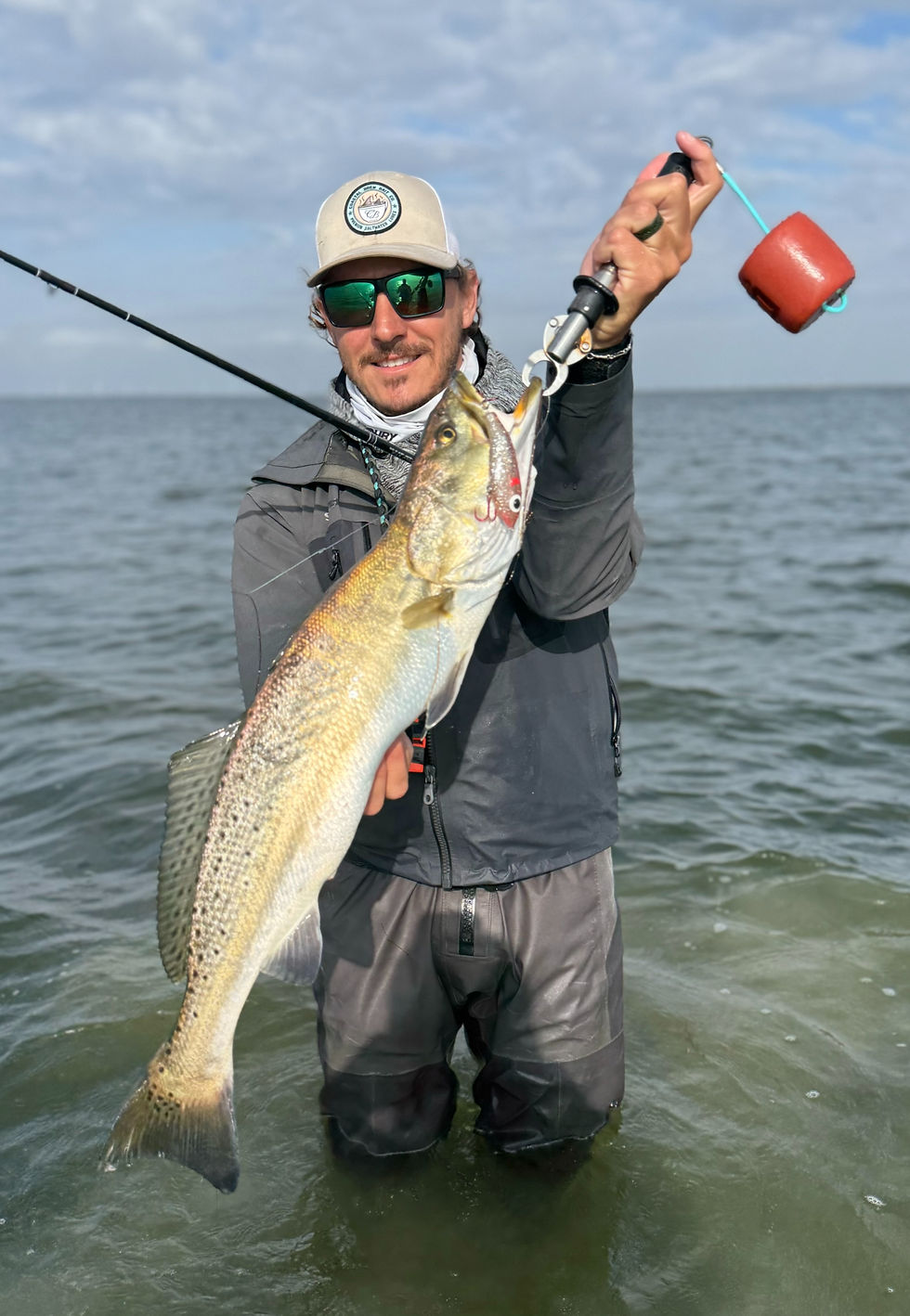
A few minutes later that good ol’ thump came around again. This time she wasn’t going anywhere. Stuck her good and she stayed down until she got close, solid 26” fish. Then another, 24”. Now you may be asking where are my customers. This brings up a good point. As a guide I rarely ever see color as the issue when clients aren’t getting bites and others are. In this situation, the action these fish wanted was very aggressive and fast. Darted half a foot below the surface was the ticket, if you were on the bottom or bouncing off the bottom you were not getting bite. Once I got Tanner and Mike dialed in to the correct presentation, this is when they started getting the right bites. Especially Tanner, the kid can fish and impresses me every time. First one he sticks comes to the surface with frothy vengeance and shows her whole belly to the world. Heavy fish with a thick gut. Tanner kept his rod horizontal, kept the rod bent for pressure and just eased that fish into his hand like a professional. Solid 27” 6.25lb fish. Great for summertime. We continued this wade to end the day around 1:00 PM when the heat got bad. We added 4 more trout between 23-25” and other slot fish. Great way to end the day. By the time 12:30 rolled around these fish had slid off into deeper water and the bait activity showed it. No more small bait jumping up shallow, only larger mullet out off the deeper drop off.
So that is how the first day went. I am hoping that by following along you guys got to see my thought process and decisions made as they were presented to me. A lot of this is time on the water and experience, that is the hard part to teach and the hard part to learn. Instinct is only taught by experience, so the more you are on the water the better you will become. But, the part I can teach is repetition. Trout don’t change much year over year, and they do use the same areas every year. This year I have caught two 30” trout since returning to Baffin in March and have had 4 come from my boat in total. Would you believe that 3 of them were caught in areas that produced 30” fish last year in the same areas? Repetition.
I hope you got something out of this article, as always feel free to text me or call me with feedback or questions. Thank you guys for the support, I truly appreciate it.
Lastly, this year I will be going to Port Mansfield in December, rather than making the journey right after new years like always. If you are looking for winter time big trout down south, I have a whole extra month to book up. Give me a call or text for more details!
Tight Lines!
Capt Eric

Comments