
MATCH THE HATCH
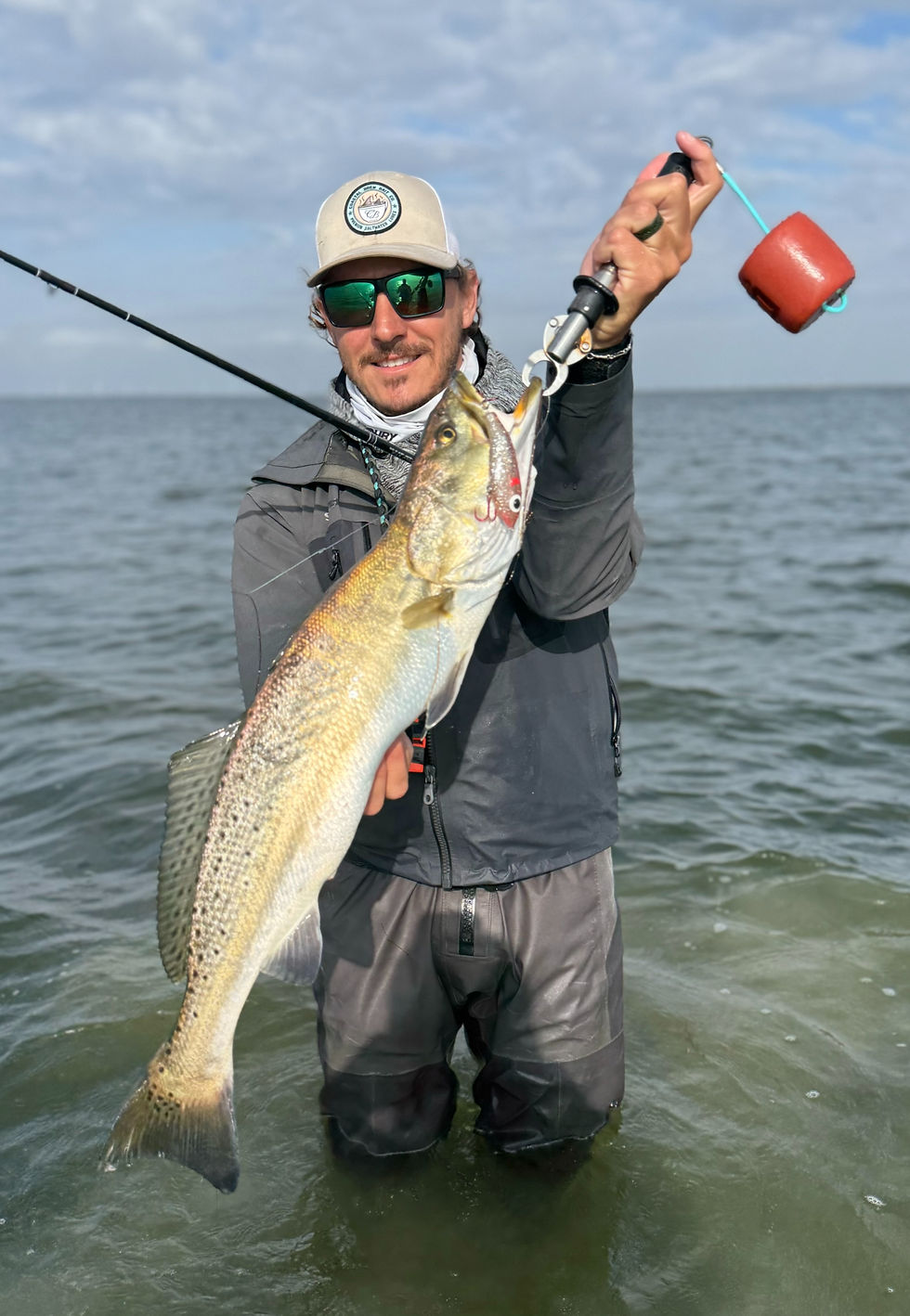
Well so far this spring has been nothing but one word, unreal. If you don’t believe me just go check Facebook. Best part is it’s only going to get better. Personally on my boat we haven’t popped one over 10 yet but we’ve had multiple over the 9lb mark and plenty in the 7-8lb range, with a healthy number of 18-22” fish. The Baffin Bay complex is in a great place and the future is bright, I can only imagine what we will be seeing in a year or two. Before getting too far down the rabbit hole of this month’s topic, just a PSA. I will not be fishing for most of June and July, therefore I will not have a July Blog or an August Blog (maybe I will pump one out for August but doubtful). Our 3rd & 4th children, twin girls, are due July 7th but expected late June so I need to take time off from work to support my wife and be in dad mode. Exciting (and scary) times, so pray for us as we prepare to pull constant all nighters.
So this month we are discussing lure colors and presentations that best “match the hatch”. It’s kind of unbelievable to think of how many fishermen just tie on a lure without putting any thought to what they are trying to impersonate. That’s kind of like an actor showing up to an audition not knowing what movie he’s trying out for, doesn’t really make sense does it? Now some will say that we are trying to imitate mullet because that’s what we look for whenever we are searching for a fishing area. True, however, are we looking for mullet because they are the prey or because they are the indication that fish are feeding? Trout do not feed on mullet alone, they will feed on whatever forage is most readily available given the season and conditions. For instance, during the Fall time we see a big migration of shrimp out of the marshes and towards the gulf. Naturally, the trout follow and set up in ambush locations along the way. Now, if I am using that pattern to find fish then why would I tie on a Super Spook? Newsflash : You wouldn’t. You have all heard me say color doesn’t matter. And as much as I still plan to die on that hill, I have changed my view slightly in that matter. No, color does not matter as much as some fishermen make it seem. You do not need to be throwing one color to catch fish, nor does one color make all the difference when you are not getting bites. PROFILE AND PRESENTATION TRUMPS COLOR EVERY TIME. However, I have started to use color for more than just light and dark. Certain colors mimic certain forage better than others in certain conditions, and for the sake of keeping this article less than 10,000 words, I am going to match the baits and color patterns I throw to certain forage.
PLASTIC – RAT TAIL
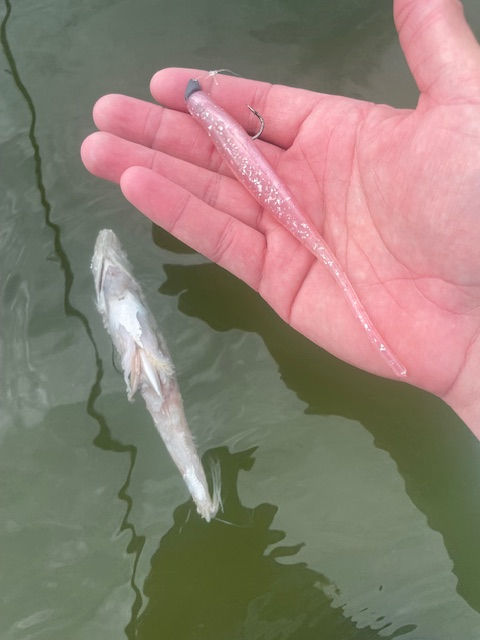
Paired with a 1/16th or 1/8th ounce jighead, you can make this profile mimic just about anything you want. Just like everything though, it mimics somethings better than others. This is where color comes into play. Coastal Brew’s Sexy Lady is an opaque pink with silver glitter and a clear(ish) belly, and if you ever look at a mullet or small pinfish on a cloudy day, you may see a slight pink flash to their scales. Take a guess as to which situation I like to throw Sexy Lady? On days of overcast skies and green water, you can be guaranteed Sexy Lady is tied on one of my rods. During the spring time I am trying to mimic small mullet that are fleeing in large f ields of horse mullet. Or, during the Fall, I am using Sexy Lady to mimic larger shrimp that are exiting the marshes and moving towards the gulf. Both situations are attempting to imitate a bait that has a slight pink hue to it, so Sexy Lady only makes sense. One of my new favorites for plastics is the new Bluff Rat color, a darker purple/blue back with pink and purple glitter and a clear belly. Put it next to a live mullet and you won’t notice much of a difference. I am always a fan of the plastics presentation year round and the reason for that is that the ways in which I can present the bait are limitless. One of my favorite scenarios is when I feel we have to force fish to eat, a scenario we find ourselves in a lot during Spring when we really have to watch our major and minor feed periods when targeting the best trout of the year. An example of this would be at the end of a feed period when activity is tapering off and trout are starting to exit their feeding grounds or simply going “dormant” in the same area. Who doesn’t love a tiny peppermint as you exit the restaurant? In situations like this I will literally move the lure like it’s life depends on it. Fast, rapid, random twitches and very brief pauses with the rod in a 12 o’clock position. If you have every seen the live action videos on Coastal Brew’s social media pages, where the lure darts past the trout at light speed and the trout chases the lure down, this is exactly what we are doing with this presentation. The perfect imitation of a small mullet or pinfish scurrying away from a larger predator which ignites a predatorial bite from the trout. Literally swatting at a pest just to kill it, or eating the bait just to keep a larger predator from eating it.
DOUBLE D (OR OTHER SHALLOW DIVERS)
The Double D is one of my favorite presentations when I am truly looking for one fish. Confidence level in this bait especially in the spring time is extremely high, and for the months of May & June I will be relying heavily on it. Color choices on this lure doesn’t matter too much so I will just list some of my favorite colors before jumping into when I like to throw it. Pearl Harbor, OG Pinky, Bay Mistress, and Crown Royal are all on the go to list on cloudy days, and Pistachio, Plum Nasty, OG Pearl Harbor and Seagrass are called upon in clear water / clear day scenarios. Working a DD is almost like a dream. Shallow sandy water, scattered grassbeds, big trout, you get the idea. During the spring we start to see a big showing of small baitfish and pinfish on the shallow flats. Trout mainly forage on small mullet and menhaden during this time, and the Double D plays the part of a scared to hell menhaden perfectly. Typically I am looking for small schools of finger mullet or skipping menhaden and I am using the same mentality as the plastic. The only diAerence is I prefer the Double D during periods of heavy feeding. It can work during the dead periods but usually trout are drifting into slightly deeper areas during these times and are not as willing to come to the surface to eat unless it is ultra skinny water and there is barely any water column. Now, most people think a DD and a topwater will work in the same scenarios and though that may be true there are some cases where a DD is the better option, or vice versa. Most know that I am not a fan of topwaters (though lately I have been throwing the a lot), what can I say I hate missing fish especially when they have the ability to come up and give me the finger. What I find is the DD works best when bait is actively being fed on, especially large bait. OAering a smaller, frantic option can be exactly what’s needed to provoke a strike. A small topwater worked aggressively can do the same thing, though I prefer the DD. I prefer a topwater to a DD when there are large rafts of mullet floating on the surface and bait activity is moderate. A topwater will create more commotion and more attraction, whereas I feel the fish almost need to be in “seek & destroy” mode to hit a DD properly. Side Note : FISH MISS A DD OFTEN. If they do, let it sit for half a second then twitch it until you get another bite. This gives the image of startled baitfish actively fleeing the predator that just tried to eat it, and instinctively draws a reaction strike from the predator more times than not.
CORKY (FAT BOY & FLOATERS)
Everyone’s favorite. Mine too, go figure. Personally if I had to pick one bait to throw I would pick a floating corky. The Fatboy is a close second, especially the new pro series. A lot of people seem to think that corkys are only a super cold weather bait, slow retrieves for lethargic fish. FALSE. During the winter we typically have less bait and only larger mullet are abundantly available. This is where a corky shines, but not because of the cold. Though large mullet can and will be eaten, trout prefer a 4-6” bait with a larger profile which is exactly what a Fatboy mimics. And no, it does not need to be worked at a snails pace. The ideal scenario for corkys is similar to a DD but take out the menhaden and add in large mullet. Small pods of mullet moving over scattered structure is perfect. The Fatboy when worked with random, erratic twitches plays the part of a f leeing baitfish or a wounded baitfish perfectly. To determine how fast you should retrieve, look at the bait activity and see what they do. If you see mullet coming out of the water with fire on their tail, move fast. If they are lazy jumping with of slapping, move fast with longer (1-1.5 seconds) pauses. The idea is never to convince a trout to bite, it is to play on their predatory instincts and create a response that gives them no choice but to bite. Whether they bite the lure due to feeding, annoyance, or competition, all these behaviors are a reaction. They do not hit a lure because they simply want to, it is purely instinct. As an angler, you should understand these instincts and learn to read the water and the bait to determine which reaction you should be looking to cause. A floater is no different in the fact that we are looking for a reaction strike however the action is different. I prefer to work a floater like a topwater with short rapid twitches with almost no pauses. Almost as if the lure is “running” just below the surface whereas the Fatboy I prefer to dart and dive just below the surface with maybe a half a second pause. Same situation, same bait presentation, just different uses based on what we are seeing that day. On days when conditions are rapidly warming after prolonged cold, I prefer the floater. When conditions are still cold and the pressure is dropping, I prefer the Fatboy.
So I hope this article gives some insight into how to mimic different bait profiles for different seasons. The best anglers I know are really good at identifying the preferred bait and acting on that observation, and this is something a weekend angler can do pretty easily to up their success rate. Pay attention and be specific!
I am offering a $100 per day discount for all dates remaining in June, and am fishing until June 11th then I am taking off until around July 20th to help with the newborns. Text or Call me with available dates!
Tight Lines!
Capt Eric Gonsoulin


Comments